

President’s Message

CRTC: After Thirty Years… Is This It?
Recently, the CRTC made a long-awaited ruling on how their new Canadian Content Definitions will apply to our work. These important decisions will impact us all in a variety of ways. While some further CanCon announcements are yet to be made by the CRTC, this first step is not promising in our fight to get more ACTRA performers on the call sheet.
Yes, there were a few positives. It was heartening to see voice performance properly acknowledged at long last, and encouraging to have updated terminology that reflects today’s industry and its evolution since the prior Broadcasting Act was passed in the 1990’s. And yes – the CRTC did include the essential AI provisions we pushed them hard for, demanding key creative roles remain in human hands. That win will hopefully help us fight the AI threat in the years to come.
But it also raises the question: What about the here and now? What does this decision do for working performers today? Particularly for members trying to land lead roles in Canadian film and television.
CanCon eligibility has long operated by using a points system that requires Canadians to be hired in several key roles, for a production to qualify as “Canadian.” When we compare the old CanCon points system with the new one, the impact (or lack thereof) becomes much clearer.
Under the old 10-point system, the path to qualifying as CanCon was narrow but predictable. A limited, yet specific, set of key creative jobs, both on and off-screen, had points values allocated, and productions had to secure 6 out of 10 points through hiring those. This would include a Canadian director or screenwriter and at least one mandatory Canadian lead performer. A second lead performer position was available, but optional, yet their hiring was attractive to a producer trying to achieve the points threshold.
The new system now expands to 15 points, introduces cultural bonus points, and opens eligibility to a wider range of jobs, from showrunners to VFX, SFX, and various design departments. CanCon eligibility is now triggered by achieving 60% of the 15 available points – which now includes interchangeable additional off-screen positions and “Cultural Bonus” points.
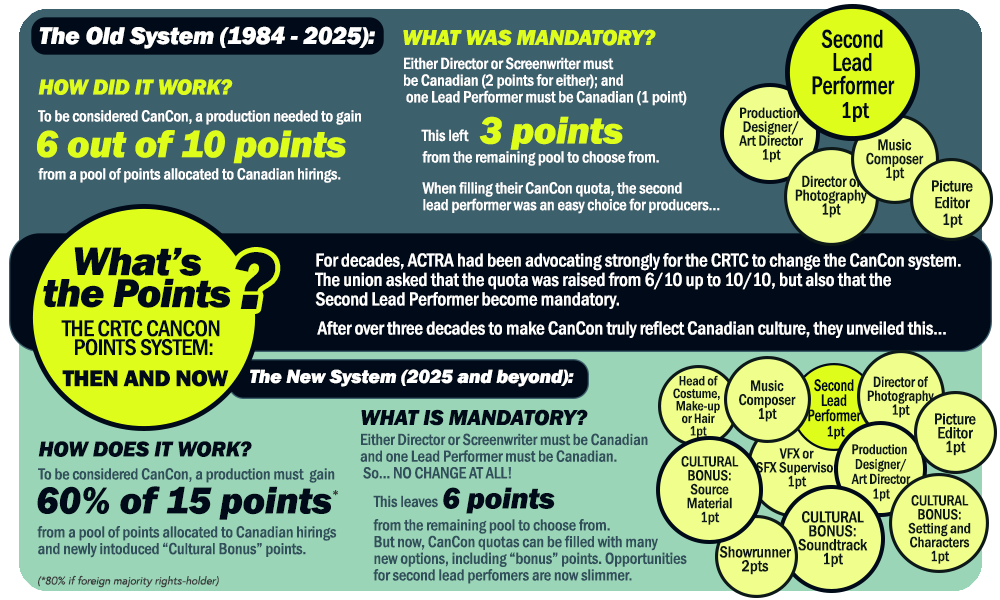
The second lead performance role must now compete with a much larger pool of available qualifying positions and bonus points. In short, a second-lead performance role is not mandatory – which ACTRA advocated strongly for – and could be regarded by producers as less economically attractive when compared to other available off-screen options on the list.
Add to these facts that we still must wait to see how spending obligations will be structured by the CRTC, and the landscape for performers becomes murkier. Contribution requirements for streamers and how those dollars will be allocated, will determine whether this broader points system strengthens the role of Canadian performers, or waters it down further. Will these decisions ultimately favour artists, or the billion-dollar streamers and broadcasters?
This sadly leaves us with one last question: Did we just wait for over three decades for a new Broadcasting Act… for this to be the result?
As always, ACTRA National will remain strong in the fight, and in the halls of power, every day. We will have much to say to the government and the CRTC as the spending requirements become clearer, and these definitions can be weighed as a whole. We will continue pressing for a system that recognizes, protects, and prioritizes the artists who bring Canadian stories to life.
In solidarity,
Eleanor Noble
ACTRA National President